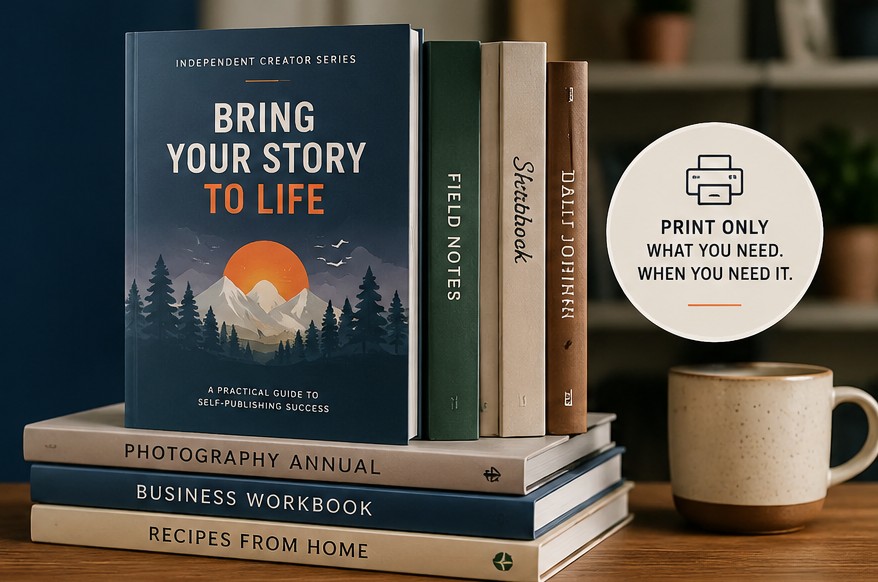



You have published your book, created an Amazon listing, and started telling people about it. Then another possibility appears: could you sell books directly to readers through your own website?
For self-published authors, that question deserves a closer look. A direct shop gives you space to present your work in your own way, offer something personal, and make buying your next book a familiar experience. It also brings practical responsibilities, from arranging delivery to answering customer questions.
The idea is attracting attention in the publishing industry. In its September 2026 outlook, the Alliance of Independent Authors identified direct sales as an increasingly established part of independent publishing. Its discussion also highlighted a central challenge: an author website needs a way to attract readers. Source: ALLi
For an author considering a first shop, the useful question is simple: can you create an offer that readers want, deliver it reliably, and keep enough from each order to make the work worthwhile?
What does selling books directly to readers mean?
Selling direct means that readers buy through a sales channel you manage, such as a shop on your author website. You choose the products, present the offer, and arrange how the order reaches the customer.
For a paperback, you might pack and ship a copy yourself. Alternatively, a print-on-demand provider may print and dispatch it after the order arrives. For an ebook, you need a delivery method that gives the customer access to the correct file and clear instructions for reading it.
You still rely on service providers, including payment processors and potentially printers or delivery platforms. However, you have more room to shape the buying experience, from the product description to the thank-you message.
Can you sell on your own website and Amazon?
Yes, in many cases you can use both. The distinction to understand is between publishing through Amazon KDP and enrolling an ebook in KDP Select.
KDP Select requires exclusivity for the enrolled ebook during its enrollment period. You cannot also sell that ebook through your website while that commitment applies. Amazon’s guidance allows print and audio editions to be distributed elsewhere. Source: Amazon KDP
That means an author could keep an enrolled ebook in Kindle Unlimited while offering signed paperbacks through an author shop. Check your enrollment dates, current terms, and any other distribution agreements before adding products. Turning off automatic renewal does not end the current KDP Select term immediately.
Think about the route that suits each format. Your paperback shop and ebook distribution do not have to follow identical plans.
Give readers a clear reason to buy direct
Before choosing a shop platform, finish this sentence: “A reader would buy this book from my website because…”
The answer should describe something meaningful to the buyer. A signed copy might make a thoughtful gift. A complete series bundle could save the reader from ordering volumes separately. A practical nonfiction book might work well with an original companion workbook, provided you hold the necessary rights and can distribute it under your agreements.
Choose an offer you can deliver comfortably. A personally signed paperback requires you to handle the book, or arrange a suitable signing process with your fulfillment provider. An automated print-and-ship order will not acquire your signature by itself.
Avoid adding extras simply to make the package look bigger. Every bookmark, gift box, or bonus download should earn its place through usefulness, reader appeal, or a sensible contribution to the price.
Check the real cost of each order
The amount a customer pays is not the amount you keep. Work through an order from payment to delivery before setting your price.
Include printing, packaging, payment processing, shipping, and any platform charges. Allow for occasional replacements or refunds, and remember that shop subscriptions, advertising, and your time also have a cost.
Here is a simplified illustration using invented figures, not supplier quotes. A customer pays $18 for a paperback plus $5 shipping, giving you $23 in total receipts. Printing costs $6, packaging costs $1, postage costs $5, and payment processing costs $1. That leaves $10 before advertising, fixed business costs, taxes, and your time.
If you spend $7 acquiring that order through an advertisement, only $3 remains before those other costs. This is why a direct sale with an attractive headline margin can still produce a disappointing result.
Use your own quotes and actual fees. Check different delivery destinations, too: an offer that works locally may become unattractive once international postage is added.
Choose a manageable way to fulfill orders
There are two straightforward starting points: keep a small supply of books and dispatch orders yourself, or connect your shop to a provider that prints and ships them.
Handling orders yourself gives you control over signatures, presentation, and inserts. It also means finding storage space, buying packaging, and making time for dispatch.
An integrated print-on-demand arrangement can reduce the need to hold stock. For example, Bookvault offers a WooCommerce integration for processing orders from a WordPress shop. Check the current setup requirements, printing costs, delivery options, and product compatibility before choosing a service. Source: Bookvault
Whichever route you choose, order a proof and test the purchase process. Check the book, packaging, confirmation email, shipping charge, and time taken to arrive. A successful payment alone does not tell you whether the whole experience works.
Do you need a large audience to start?
A large following is not a prerequisite for a small experiment. You do need a credible way to reach people who might want your book.
For a nonfiction author, that could be a useful article answering a problem the book explores in more depth. A novelist might introduce a signed edition to existing readers. An author attending a local event could direct interested visitors to a product page with a memorable web address.
Build the page around the reader’s questions. What is the book about? Who is it for? Which edition will arrive? Is it signed? What is the total cost? When should the buyer expect delivery?
Give visitors a separate, clear choice to subscribe to updates. Describe what they will receive and how often you expect to send it. A purchase confirmation and a newsletter serve different purposes; design the experience so readers understand both.
Start with one book and one clear offer
A first shop does not need a large catalog. A focused launch makes it easier to identify what works and fix what confuses customers.
Choose one title with a clear audience. Decide whether you will offer a standard paperback, signed edition, or simple bundle. Build a product page with an accurate cover image, a useful description, format details, delivery information, and a visible contact route.
Test the checkout on a phone as well as a computer. Confirm that the shipping destinations you intend to serve are available and that unsupported destinations cannot place an order accidentally. Review the policies and tax settings relevant to your business before launch.
Then introduce the offer through a channel where you already have some connection with readers. Keep the first promotion small enough that you can answer questions and handle orders without rushing.
Measure what the first launch teaches you
Record product-page visits, completed orders, revenue, direct costs, and time spent supporting customers. These figures help you diagnose different problems.
If few people visit, you need to work on attracting relevant readers. If people visit but leave at checkout, investigate delivery charges, technical problems, payment options, and whether the offer is clear. If orders arrive but take too much time to process, simplify fulfillment before increasing promotion.
Set a review point, such as after 30 days, while recognizing that a handful of visits cannot establish whether an offer has commercial potential. Look for useful evidence rather than treating the first month as a final verdict.
Is selling direct right for your books?
Selling directly to readers is worth testing when you have a specific offer, a way to reach its audience, and a delivery process you can manage. It may be better to wait if your book still needs production work or you have no time to support customers.
Begin with the smallest useful version of the idea. Price one book properly, create a trustworthy product page, and send a few readers to it. Their questions and buying decisions will give you a clearer basis for your next step than building an elaborate shop before anyone has ordered.
What would make you buy a book directly from its author: a signed copy, a series bundle, or an exclusive extra? Share your thoughts in the comments.
Frequently asked questions
Can I sell my paperback directly if my ebook is in Kindle Unlimited?
Yes. KDP Select’s ebook exclusivity does not prevent you from distributing a print edition elsewhere. Check the current terms and any other agreements affecting your book before launching the offer.
Do I have to keep books at home?
No. You can use a suitable print-on-demand fulfillment service. Holding a small stock yourself may be more practical if you want to sign each copy personally or include customized packaging.
Will I earn more by selling books through my website?
Possibly, but it depends on the complete cost of the sale. Compare what remains after printing, transaction charges, delivery, advertising, and overheads. Include the time needed to run the shop.
What should a new author sell first?
Start with one book or a simple offer you can describe clearly and deliver reliably. Use early customer questions and actual order costs to decide whether to expand.