


Lulu Print on Demand: Everything Self-Published Authors Need to Know
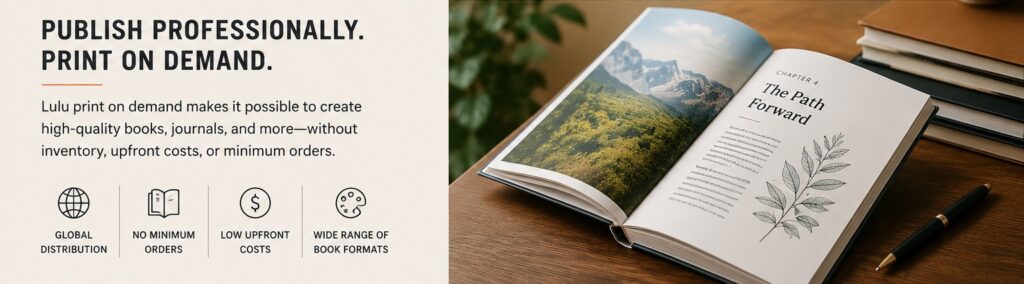
If you’re looking for a way to publish books without ordering inventory, renting warehouse space, or investing thousands of pounds upfront, Lulu print on demand may be worth considering.
Print-on-demand (POD) publishing has transformed the self-publishing industry by allowing authors to print books only when customers place an order. Instead of purchasing hundreds of copies and hoping they sell, books are produced individually and shipped directly to readers.
Among the many POD providers available today, Lulu has established itself as one of the longest-running and most versatile platforms for independent authors, educators, businesses, and creators.
In this guide, we’ll explore how Lulu print on demand works, its advantages and disadvantages, pricing considerations, distribution options, and whether it is the right choice for your publishing project.
What Is Lulu Print on Demand?
Lulu is a self-publishing platform that allows creators to produce and distribute books without maintaining inventory.
Authors upload their manuscript files and cover designs, choose a trim size and binding type, and make the book available for purchase. When a customer orders a copy, Lulu prints, binds, and ships it.
This means there is no minimum order quantity and no need to purchase stock in advance.
Lulu supports a wide variety of book formats, including:
- Paperback books
- Hardcover books
- Coil-bound books
- Magazines
- Journals
- Workbooks
- Photo books
- Calendars
- Educational materials
Because of this flexibility, Lulu is often used for projects that extend beyond traditional novels.
How Lulu Print on Demand Works
The publishing process is relatively straightforward.
Step 1: Prepare Your Manuscript
Your interior file should typically be submitted as a print-ready PDF.
Common requirements include:
- Embedded fonts
- Correct page sizing
- Appropriate margins
- High-resolution images
- Proper bleed settings where required
Step 2: Create a Cover
Lulu provides templates that correspond to your chosen trim size and page count.
The cover file must usually include:
- Front cover
- Spine
- Back cover
As page count changes, spine width changes too, making it important to finalize the manuscript before completing cover design.
Step 3: Upload Files
Once files are uploaded, Lulu runs automated checks to identify common formatting issues.
Authors can then preview their book before approving it for publication.
Step 4: Order a Proof Copy
Although not mandatory, ordering a proof copy is strongly recommended.
A printed proof allows you to check:
- Print quality
- Margins
- Image clarity
- Cover alignment
- Spine text placement
Many publishing mistakes only become obvious when viewed in physical form.
Step 5: Publish and Distribute
After approval, books can be sold through Lulu’s marketplace or distributed to major retailers.
Orders are then fulfilled automatically as they arrive.
What Types of Books Work Best with Lulu?
Lulu excels in several categories that are often underserved by other POD platforms.
Educational Resources
Teachers and trainers frequently use Lulu to produce:
- Course materials
- Training manuals
- Study guides
- Workbooks
Journals and Planners
The platform’s variety of binding options makes it particularly attractive for:
- Daily planners
- Gratitude journals
- Fitness logs
- Business notebooks
Graphic-Heavy Books
Books containing diagrams, photographs, illustrations, and colour pages can often benefit from Lulu’s printing options.
Limited-Audience Publications
Some books appeal to niche audiences and may only sell a handful of copies each month.
Examples include:
- Family histories
- Local history books
- Technical manuals
- Specialist hobby guides
Print-on-demand allows these projects to remain available indefinitely without inventory costs.
Lulu vs Amazon KDP
Many authors compare Lulu directly with Amazon KDP.
Both platforms offer print-on-demand services, but they serve slightly different purposes.
Amazon KDP Advantages
- Access to Amazon’s marketplace
- Simpler publishing workflow
- Massive customer base
- Strong integration with Kindle ebooks
Lulu Advantages
- More binding options
- Greater format flexibility
- Better suited for specialty publications
- Strong options for educational materials
Many experienced self-publishers actually use both platforms rather than choosing one exclusively.
Lulu vs IngramSpark
Another common comparison is Lulu versus IngramSpark.
IngramSpark Strengths
- Extensive global distribution
- Strong bookstore relationships
- Professional publishing focus
Lulu Strengths
- Simpler setup process
- Easier for beginners
- Greater product variety
- Useful for niche publishing projects
For authors seeking widespread bookstore distribution, IngramSpark often receives the edge. For creators producing journals, workbooks, manuals, and specialist publications, Lulu may offer a more straightforward solution.
Advantages of Lulu Print on Demand
No Inventory Risk
You never need to purchase large quantities of books.
This significantly reduces financial risk for new authors.
Global Fulfilment
Books can be printed and shipped to customers in numerous regions worldwide.
Broad Product Range
Few POD providers support as many product formats as Lulu.
Low Startup Costs
Publishing can begin with little more than a manuscript, cover design, and proof copy.
Suitable for Small Audiences
Even books that sell only a few copies per year can remain available.
Potential Drawbacks
No publishing platform is perfect.
Lower Profit Margins
Print-on-demand costs are generally higher than offset printing.
As a result, royalties per book may be lower.
Competitive Marketplace
Simply publishing a book does not generate sales.
Marketing remains essential.
Distribution Limitations
Depending on your goals, other platforms may offer broader retail reach.
Learning Curve
Formatting print-ready files correctly requires attention to detail.
How Much Does Lulu Print on Demand Cost?
Costs vary according to:
- Page count
- Book size
- Colour or black-and-white interiors
- Binding type
- Paper quality
- Distribution settings
A 100-page black-and-white paperback will cost substantially less to produce than a 300-page full-colour hardcover.
Before publishing, authors should calculate:
- Printing cost
- Distribution fees
- Retail price
- Expected royalty
Understanding these figures helps avoid pricing books too low.
Is Lulu Print on Demand Good for First-Time Authors?
For many beginners, yes.
Lulu offers a relatively accessible entry point into self-publishing while providing more flexibility than some competitors.
Authors creating:
- Journals
- Workbooks
- Educational materials
- Niche non-fiction books
- Graphic-heavy publications
may find it particularly useful.
However, writers whose primary goal is maximising Amazon sales often choose Amazon KDP as their first platform and then explore additional distribution options later.
Final Thoughts
Lulu print on demand remains one of the most established and flexible self-publishing platforms available today.
Its ability to support everything from novels and journals to training manuals and full-colour publications makes it an attractive option for independent creators who want professional-quality books without inventory risk.
While it may not be the perfect solution for every author, it offers an effective way to bring a publishing project to life with minimal upfront investment.
As with any self-publishing platform, success ultimately depends less on where your book is printed and more on the quality of the content, the professionalism of the presentation, and the effectiveness of your marketing strategy.