


Publishing a Self Publish Graphic Work
If you want to self publish graphic novel work, you are entering one of the most exciting areas of independent publishing. A graphic novel is not just a book. It is storytelling, design, branding, visual pacing, and production all at once. That is exactly why self-publishing can suit it so well. You are not handing over your idea and hoping someone else understands it. You are shaping the entire reading experience yourself.
For many creators, that level of control is the biggest advantage. You decide how the book looks, how long it is, what trim size it uses, what kind of paper experience you want readers to have, how the cover presents the story, how much it costs, and where it will be sold. You also keep the flexibility to sell direct, create collector editions, test digital pricing, or build a series without waiting for approval from a traditional publisher.
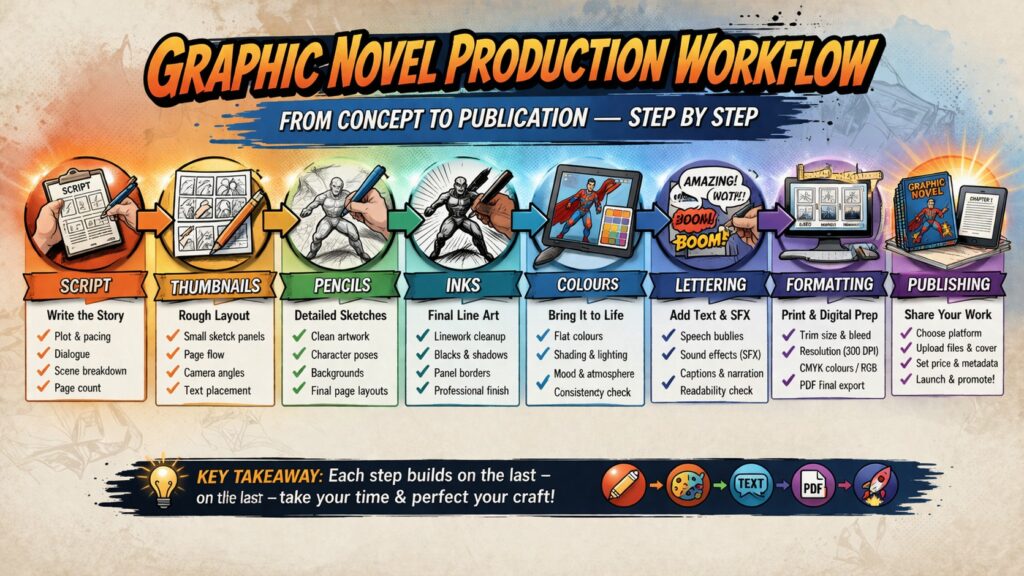
Still, freedom is only useful if you know what to do with it. A lot of creators finish the artwork and then realise they are less sure about the publishing side. They know how to draw the book, but not how to package, price, upload, and launch it properly. That is where a clear process helps. Self-publishing a graphic novel becomes far less overwhelming when you move through it step by step.
Step 1: Finish the Book Properly Before You Publish
The first step is obvious, but it is also where many creators rush. Your graphic novel should be finished before you start seriously thinking about publication. That means not nearly finished, not mostly finished, and not good enough for now. It should be complete.
The script needs to work. The page turns need to feel intentional. The dialogue needs to be readable. The artwork needs to feel consistent from beginning to end. The lettering needs to be clear and placed with care. If your story has emotional beats, action sequences, reveals, or shifts in tone, those moments should already land the way you want them to.
A graphic novel is especially vulnerable to rushed finishing because readers notice inconsistency quickly. If your first third looks polished and the last third feels hurried, it will show. If some speech balloons are clean and others are cramped, it will show. If you changed your colouring method halfway through and never fully harmonised it, that will show too.
So before you move on, go through the book page by page and ask yourself a few hard questions. Can every line of dialogue be read easily? Does every spread guide the eye naturally? Are there any scenes that feel slower than they should? Have you proofread every word? Have you checked names, continuity, panel order, and visual details from chapter to chapter? This stage is not glamorous, but it protects the quality of everything that follows.
Step 2: Decide What Kind of Graphic Novel You Are Publishing
Once the book is complete, decide exactly what form it is going to take. This affects both production and pricing.
Some creators want a standard comic-style format. Others want a bookstore-style trade paperback. Others want a premium hardback edition for collectors. Some want digital only. Some want print and digital together. None of these choices is automatically correct. The right one depends on your goals.
If this is your first project and you want lower financial risk, the most practical route is often a paperback print-on-demand edition plus a digital PDF version. That gives readers a physical option and a lower-cost digital option without forcing you to buy large print runs upfront.
If your work is especially visual, highly detailed, or prestige-driven, a hardback may suit it later, but many first-time creators start with paperback because it is more accessible for both seller and buyer.
At this point, write down your publishing decision in one simple sentence. For example: “I am releasing a 140-page black-and-white paperback graphic novel in print-on-demand, plus a digital PDF edition.” Or: “I am releasing a 96-page full-colour graphic novel in paperback first, with a collector hardback later.” Once that is clear, later decisions become easier.
Step 3: Choose Your Trim Size and Interior Style
Your trim size is the physical size of the book. This matters more for a graphic novel than it does for many text-only books because page size changes the reading experience. A compact trim can make art feel dense and intimate. A larger trim can make action scenes and environments breathe.
You should also decide whether the interior is black and white, greyscale, or full colour. Full colour can look fantastic, but it raises production costs. Black and white can be beautiful too, especially if the artwork was designed with contrast, atmosphere, and texture in mind.
Think carefully about readability. Tiny text or cramped panels may look acceptable on a large monitor while you are designing, but feel frustrating in print. If your pages are busy, leave room. If your dialogue is substantial, test it at real book size rather than guessing on screen.
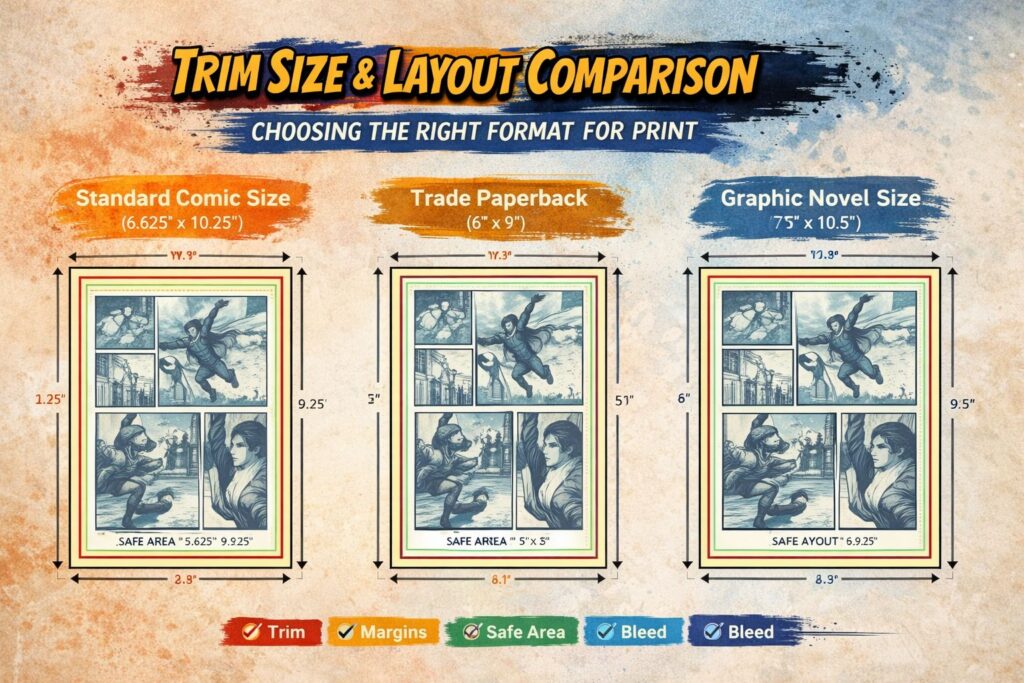
Step 4: Prepare the Artwork and Export Files Correctly
This is one of the most technical steps, but it is one of the most important. If your files are not prepared correctly, the printed book can look muddy, misaligned, or amateurish no matter how good the art is.
Your pages should usually be prepared at 300 DPI for print. Your colour mode should suit the destination format. For print, that often means preparing with print outcomes in mind, while digital display may look brighter on screen. You also need to account for bleed, safe margins, and trim. Anything important placed too close to the edge risks being cut off.
When exporting, review a sample carefully. Zoom in. Check speech bubbles. Check line sharpness. Check blacks and shadows. Check whether thin lines hold up. If possible, print a few test pages at home or order a proof copy before release. Many creators skip this and regret it later.
Step 5: Create a Professional Cover That Sells the Story
A graphic novel cover is doing two jobs at once. It has to look like art, and it has to function like marketing. A beautiful illustration alone is not always enough. The cover must also communicate what kind of experience the reader is about to buy.
Your title should be readable even as a thumbnail. The imagery should suggest the story’s mood. The design should feel deliberate. If your graphic novel is tense, strange, funny, romantic, epic, sinister, or whimsical, the cover should hint at that immediately.
Do not treat the cover as an afterthought just because the interior took most of your energy. Online, the cover is often the first thing readers see. It is what makes them click, pause, or keep scrolling.
Step 6: Write the Book Description and Metadata
Now you need to think like a publisher. That means writing the listing text that will help readers understand and find your book.
Your book description should not sound flat or over-explanatory. It should give enough to intrigue without draining all the energy out of the premise. Focus on conflict, character, world, tone, and stakes. Think of it as an invitation into the story.
You will also need categories, keywords, subtitle decisions if appropriate, author name presentation, and edition information. Because your target keyword is self publish graphic novel, it is worth remembering from an SEO perspective that discoverability matters on blogs and websites just as much as it does on retail listings. For your actual graphic novel product page, though, reader appeal matters more than awkward keyword stuffing.
Step 7: Choose Where to Publish
This is the stage where your book moves from project to product. There are several routes you can take.
Many indie creators begin with Amazon KDP because it is simple and convenient for print-on-demand paperbacks. Others add IngramSpark for broader distribution options. Some sell digital files directly through their own site or storefront. Some use crowdfunding to fund a print run before publication.
You do not have to choose only one route forever. You can start with the easiest release model and expand later. A practical early strategy is often to publish paperback through a print-on-demand platform and offer a direct digital edition through your own site or shop.
That setup gives you reach, low upfront risk, and an option to earn a better margin on direct sales.
Step 8: Set Your Pricing Carefully
Pricing is where many creators hesitate, especially if this is their first book. They worry about charging too much, so they charge too little. But graphic novels take a huge amount of labour to create. Your price should reflect not just page count, but value, production cost, audience expectations, and market positioning.
A very low price can sometimes make the book look less professional rather than more attractive. A sensible price signals that this is a real product with care behind it.
Here is a practical graphic novel pricing guide you can use as a starting point.
Digital PDF Edition
For a shorter graphic novel, novella-style comic, or first volume:
US dollars: $4.99 to $8.99
British pounds: £3.99 to £6.99
For a longer, more substantial full-length graphic novel:
US dollars: $7.99 to $12.99
British pounds: £5.99 to £9.99
A strong starting point for many indie creators is:
US dollars: $6.99 or $7.99
British pounds: £4.99 or £5.99
Paperback Edition
For a shorter paperback graphic novel:
US dollars: $12.99 to $16.99
British pounds: £9.99 to £12.99
For a longer or premium-feeling paperback edition:
US dollars: $16.99 to $24.99
British pounds: £12.99 to £18.99
A common starting point for a professionally presented indie paperback is:
US dollars: $14.99 to $18.99
British pounds: £10.99 to £14.99
Hardcover Edition
For a shorter premium hardback:
US dollars: $19.99 to $27.99
British pounds: £15.99 to £21.99
For a longer or collector-style hardback:
US dollars: $24.99 to $39.99
British pounds: £19.99 to £29.99
Signed or Special Edition Pricing
If you are selling directly and signing copies, adding extras, or bundling art prints or bookmarks, you can charge more.
A sensible uplift might be:
US dollars: add $5 to $15
British pounds: add £4 to £12
That extra amount can help cover packaging time, signatures, inserts, and the more personal value of the edition.
Bundle Pricing
If you offer paperback plus digital together, give the reader a reason to buy both.
Examples:
Digital only: $6.99 / £4.99
Paperback only: $15.99 / £11.99
Bundle: $17.99 to $19.99 / £13.99 to £15.99
This kind of pricing makes the bundle feel like a better deal without collapsing the value of the print edition.
Step 9: Work Out Your Minimum Viable Profit
Before settling on a price, calculate what you actually need. Look at print costs, platform fees, packaging if selling direct, and any promotional spend.
Then ask yourself three things. First, what does it cost to produce one copy? Second, what do I earn after fees? Third, does that amount still make sense for the work involved?
You do not need a huge margin on every copy at the start, but you do need clarity. It is better to choose a price intentionally than to guess and discover later that your profits are tiny or nonexistent.
Step 10: Build Interest Before Launch Day
Once pricing is in place, do not wait for launch day to start talking about the book. That is one of the biggest mistakes indie creators make.
Readers like to see a book taking shape. They like to feel invited into the process. This is especially true for a graphic novel, where the art itself becomes part of the marketing.
Share character designs, cropped panels, cover previews, inking progress, lettering shots, world-building notes, and short behind-the-scenes thoughts about the story. Let readers see what kind of world they are stepping into.
If you have an email list, start using it. Tell subscribers what the book is, when it is coming, and why it matters. If you do not have a list yet, begin collecting interested readers before launch.
Step 11: Launch With a Clear Plan
A launch works best when it feels like an event, even if you are a solo creator with a modest audience.
In the weeks before launch, begin your build-up. Reveal the cover. Share sample pages. Talk about the release date. Give people a reason to anticipate the book rather than merely notice it after it appears.
In launch week itself, post consistently. Send an email announcement. Remind readers where they can buy it. Share early reactions if you have them. If you are using a launch price or bundle, make that clear.
The point is not to sound loud or artificial. The point is to make the release visible, coherent, and easy to act on.
Step 12: Keep Promoting After Publication
Publication is not the end of the process. It is the start of your book’s public life.
After launch, keep talking about the graphic novel. Share reader photos, favourite panels, review snippets, process notes, and posts about what inspired certain scenes or character moments. A book does not vanish just because release week is over.
This is where many creators accidentally lose momentum. They put everything into launch day and then go quiet. But readers discover books at different times. Continued visibility helps the book keep finding people.
A Simple Example Pricing Setup
If you want a straightforward model that feels professional without being too complicated, here is a solid starting structure for an indie full-length graphic novel:
Digital edition: $6.99 / £4.99
Paperback edition: $16.99 / £12.99
Signed direct edition: $21.99 / £16.99
Print + digital bundle: $18.99 / £13.99
This kind of structure gives readers choice while keeping the book’s value intact.
Common Mistakes to Avoid
The most common mistake is publishing too early. The second is underpricing. The third is assuming the book will somehow find readers by itself.
Other common problems include poor file preparation, weak cover design, unreadable lettering, inconsistent formatting, vague product descriptions, and a lack of launch build-up. None of these problems is impossible to solve, but it is far better to address them before publication than after disappointed readers begin to notice them.
Final Thoughts
To self publish graphic novel work successfully, you need more than talent. You need patience, structure, and a willingness to move between art and publishing decisions without losing sight of the reader. The creative side matters deeply, but so do presentation, pricing, and discoverability.
The good news is that you do not have to master everything at once. You simply need to move through the process step by step. Finish the book properly. Choose the right format. prepare the files carefully. Design a strong cover. Write the listing well. Set a price that respects the work. Build an audience before launch. Keep promoting after release.
That is how a private creative project becomes a published graphic novel readers can actually buy, enjoy, and remember.
And that, ultimately, is the goal. Not just to make the work, but to bring it fully into the world.
I can turn this next into a Word-style article, a web-ready SEO blog layout, or a downloadable guide with extra generated images.